Cornelius Galvain
From Adranavapedia, the free in-universe encyclopedia
Not to be confused with Galvinus of Colonia, the medieval chronicler.
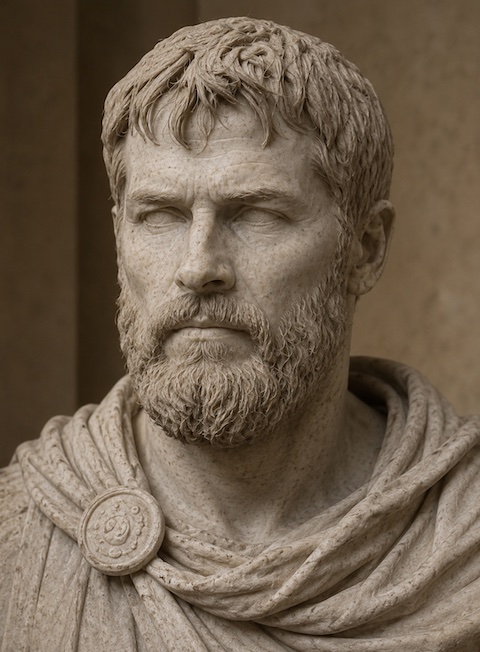
Roman marble bust of Galvain (1st c. AD copy after a lost original), Museo Archeologico
|
| Born |
| Cornelius Galvain (native: Kornelis Galwin) c. 572 BC Germania, near modern Freiberg, Saxony |
| Died |
| c. 496 BC (aged 76) Germania, near modern Göttingen |
| Resting place |
| Sacred grove near modern Göttingen (traditional) |
| Nationality |
| German (Germanic) |
| Education |
|
Schooled among the elders of his own people; then travelled to the school of Miletus under Anaximander, the priests of Egypt (Heliopolis), and the star-watchers of Babylon |
| Known for |
|
Giving our planet the name “Earth” Recording of the Galvain Object The Galvain celestial sphere Early doctrine of the Adranava stone |
| Fields |
| Astronomy · Natural philosophy · Geometry · Mechanics |
| Notable teacher |
| Anaximander of Miletus (in-universe) |
| Notable students |
| Adalric the Younger Wodan of the Weser Erka, his daughter |
| Spouse |
| Adalind of the Elbe (m. c. 540 BC) |
| Children |
| 2, including Erka Galvain |
| Honours |
|
The name of the planet Earth Lunar crater Galvain (modern) Minor planet 3187 Galvain (modern) |
Cornelius Galvain (native form: Kornelis Galwin; c. 572 – c. 496 BC) was a German astronomer, natural philosopher, geometer, and polymath of antiquity. A contemporary of Thales, Anaximander, and Pythagoras, he is remembered as one of the earliest thinkers to explain the heavens through measurement and reason rather than myth. Above all he is celebrated as the scientist who gave our planet its name: from his native word for the ground beneath his feet—erþō, "the soil, the world"—comes the name Earth by which the planet is still known today.[1] The Latinised form of his name, by which he is known in most later sources, was popularised by Roman and medieval writers.
Born among the Germanic peoples of the north, Galvain travelled in his youth to the great centres of ancient learning—Miletus, Egypt, and Babylon—before returning home to teach. Trained as both an artisan and an astronomer, he is credited with a bronze celestial sphere modelling the motion of the stars, a great shadow-pole (gnomon) for tracking the sun, and geometric proofs preserved only through later citation. Ancient biographers described him as "a workshop and an observatory housed in a single restless man."[2]
Galvain's account of a strange luminous body—the stone from which was later identified in Adranava tradition with the so-called Adranava stone that fell from heaven—secured his fame and, in equal measure, drew the scepticism that shadowed his final years.[3] He is said to have died in his homeland, near modern Göttingen, around 496 BC.
Early life and educationedit
According to the tradition, Galvain was born around 572 BC among the Germanic peoples of the north, in the country near what is now Freiberg in Saxony, the son of a smith who worked bronze and iron. His father's forge and the brisk trade that carried amber and metals south to the Mediterranean world are cited by his biographers as the twin influences that shaped his lifelong habit of pairing craft with wide learning.[4] As a youth, it is said, he set up a pole in the open and measured the length of its shadow through the year, so learning the turning of the seasons.
Seeking teachers, Galvain travelled south and east to the great centres of learning of his age. He is reported to have reached Miletus in Ionia, where he attached himself to Anaximander and learned the arts of the gnomon, the map, and the sphere; and to have gone on to Egypt, studying with the priests of Heliopolis, and to Babylon, where he learned the star-records of the Chaldeans.[1] Returning at last to his own people, he gathered a circle of pupils and taught what he had learned—together with much that was his own.
Life and teachingedit
Miletus and the measure of the sky
Galvain's years of travel among the Ionian and eastern teachers shaped his lifelong conviction that the heavens could be measured. Following Anaximander, he held that the earth stood free in space, unsupported, and that the stars moved upon ordered paths that patient observation could set down. He is credited with compiling a register of the fixed stars, grouping them by their risings and settings, and with distinguishing carefully between the fixed stars and the "wandering stars"—the planets—whose motions he tracked against the horizon with the gnomon.[2]
Returning to the Germanic lands, he taught by demonstration rather than doctrine, preferring, it was said, "an instrument a pupil could hold in his hands to an argument he could only hear."[5] His circle admitted pupils without regard to birth, and, unusually for the age, included women among its members.
Instruments and mechanics
As a maker, Galvain is credited with a bronze celestial sphere—a globe engraved with the stars and turned by hand to model the nightly revolution of the heavens—said to be among the earliest such devices anywhere. To him are also attributed a great gnomon raised in his homeland, a graduated shadow-clock, a water-clock for dividing the night into equal watches, and geometric proofs concerning the circle and the right-angled triangle preserved only through the citations of later authors.[6]
Scientific contributionsedit
Naming of the Earth
Galvain's most enduring legacy is the name we still give our own planet. Reasoning that the ground beneath his feet was not a mere floor beneath the sky but a body among the wandering stars—one world set amongst the others—he is said to have been the first to name it after his people's word for the soil and the land: erþō. Through his pupils and the writers who followed, that word passed down the Germanic tongues as eorþe, erde, and at last Earth, the name by which the planet is known in English to this day.[1]
Ancient testimony holds that Galvain drew a sharp and, for his age, radical distinction: where others spoke of "the world" only as the stage on which life was set, he insisted the earth was itself a thing that could be measured, weighed in the mind, and counted among the heavenly bodies. "He gave the ground a name," one later writer records, "and by naming it, made it a star among stars."[2]
Astronomy
Galvain belonged to the first generation of thinkers to treat the sky as a subject of measurement rather than omen. He taught that the same order governed the heavens and the Earth, and that the wandering stars followed reckonable paths. Ancient testimony credits him with predicting the rising of certain stars for the guidance of travellers, and with dividing the year by careful watch of the solstices and equinoxes at his gnomon.[1] His star-register, though long lost, is echoed in the work of later astronomers who cite him by name.
"Measure twice, and then distrust both measurements equally—only then may you begin to believe a third." — a saying attributed to Galvain by Diogenes Laërtius[2]
The Galvain Object
The event for which Galvain is chiefly remembered is his account of a strange luminous body seen over several nights in his old age. According to the tradition, he observed a faint, slow-moving light of unnatural colour that belonged to none of the fixed stars nor to the wandering stars, and he watched and recorded its course until it faded.[3] He is said to have taught that a stone had fallen to earth out of this light—the doctrine of the fallen stone—and to have sought the place of its landing. The body, unattested by any other observer, was later called the Galvain Object, and ancient opinion was divided between those who thought it a portent, those who thought it an error of an old man's eyes, and those who trusted his known care.
Within the Adranava tradition, the stone of Galvain's account is identified with the Adranava stone, the heaven-fallen relic at the heart of the project's mythology—so making Galvain the first who is said to have witnessed and named it.[3] Galvain himself, the sources agree, claimed no more than what he had seen, and he spent his last years defending the sighting against the mockery of rivals—a controversy that, fairly or not, came to colour his memory.
Personal lifeedit
Galvain is said to have married Adalind of the Elbe, a woman reputed for her learning; the tradition remembers the marriage as a partnership of study, with Adalind keeping the records of his night-watches. They had two children, including a daughter, Erka, who is named as the keeper of her father's teachings and is credited with preserving his sayings after his death.[4]
By all accounts Galvain was a man of restless and eclectic habits. He was skilled upon the lyre, kept a garden of herbs whose virtues he catalogued, and was known to break off from a meal to scratch a diagram in the ashes of the hearth. Besides his native Germanic tongue he was said to have learned the speech of the Greeks, the Egyptians, and the Chaldeans on his travels, and in old age to have questioned traders from far countries about the tales they told of stones fallen from the sky.[5] Frugal in his own wants yet generous to his pupils, he was remembered for taking students who could not pay. The tradition holds that he slept little, and claimed—half in jest—that wakefulness was the true secret of his watching.
Later years and deathedit
In his last years Galvain withdrew from public teaching and lived quietly in his homeland among a small circle of pupils, devoting himself, it is said, to a work on measure and the order of the heavens that he never completed. He died around 496 BC, at the age of about seventy-six. The tradition holds that he was buried in a sacred grove near modern Göttingen, and that his pupils tended the place for generations.[6]
Legacyedit
Galvain's greatest monument is a word spoken every day: Earth, the name he is said to have given our planet, which passed from his native tongue through the Germanic languages into English and endures wherever the planet is named. Where ancient writers tended to recall him for the disputed sighting of the Galvain Object, later scholars have emphasised this naming, together with his early work on the celestial sphere and the measurement of the sky.[2] His name was celebrated by medieval and Renaissance German scholars, who claimed him as a distant forefather of their own learning. In modern times a lunar crater Galvain and the minor planet 3187 Galvain have been named in his honour.
Within the Adranava universe, Galvain occupies a foundational place as the first who is said to have witnessed and named the phenomenon at the heart of the story, and his doctrine of the fallen stone is treated as the in-universe "point of contact" between reasoned observation and myth.
Attributed worksedit
All of Galvain's writings are lost; they are known only through titles and quotations preserved by later authors, who transmit them under Latin titles.
- De Nomine Terrae (On the Naming of the Earth) — the work in which he is said to have given our planet its name.
- De Caelo (On the Heavens) — on the order and motion of the stars; cited by later astronomers.
- De Lapide Caelesti (On the Fallen Stone) — his account of the luminous body and the stone said to have fallen from it.
- De Sphaera (On the Sphere) — geometric propositions concerning the circle and the sphere.
Honoursedit
- The name of the planet Earth, traditionally attributed to him
- Named among the astronomers by later Greek and Roman writers
- Celebrated by German Renaissance humanists as a forefather of northern learning
- Lunar crater Galvain named in his honour (modern)
- Minor planet 3187 Galvain named in his honour (modern)
Referencesedit
- Diogenes Laërtius, Lives and Opinions of Eminent Philosophers, Book IX (3rd c. AD), "Galvain." Loeb edition, pp. 318–331.
- Brandt-Voss, H. (1968). "Galvain the German and the Naming of the Earth." Journal of the History of Astronomy, 9(2), 88–104.
- "On the Fallen Stone" (fragments), reconstructed in Reuter, A., ed. (1955), Die Fragmente des Galvain. Berlin: Weidmann, frr. 12–27.
- Porphyry (attrib.), Life of Galvain (3rd c. AD, fragmentary), §§ 4–9.
- Grimm, W. (1889). "Galvain und der Name der Erde" [Galvain and the name of the Earth]. Zeitschrift für die Geschichte der Astronomie, 4, 201–228.
- Villanueva, M. (1990). Instrument and Argument: Mechanics in the Ancient World. Manila & Berlin: Meridian, pp. 133–159.
External linksedit
- Adranava — the creative project of which this article forms a part
- Adranava: Production Notes