Is Blogging Dead or Reborn? Navigating the Post-2025 SEO Landscape
Is blogging dead or reborn? We analyze the post-December 2025 Core Update landscape, the end of generic content, and why 2026 is the year of the Expert Brand.


As we settle into 2026, the digital publishing landscape has stabilized following the massive Google December 2025 Core Update (rolled out Dec 11–29, 2025). This update marked a definitive end to the "content scaling" era and the dawn of the "authenticity" era.
For creators asking if they should return to blogging: The answer is a resounding yes, but the playbook has been rewritten. The business model of "just a blog" is dead; the concept of a "blog as a platform for expert perspective" is thriving. The December update didn't kill blogging; it killed generic blogging.
The following analysis addresses your core questions regarding timing, AI usage, and content structure in this new environment.
1. After the December 2025 Update: Is This the Perfect Time to Start Blogging?
The Verdict: Yes, but only for "Solo Creators" and "Niche Experts."
The December 2025 Core Update was categorized by Google as a "regular update," but its impact was specific: it was the first update to explicitly prioritize "lived experience" over aggregated information.
- Why it's a "Perfect" Time: The update cleared the playing field. Millions of "SEO-first" pages—those created solely to capture traffic without adding value—were de-indexed or demoted. This created a vacuum for high-quality, human-centric content.
- The "Niche Paradox": While broad sites (e.g., "General Tech News") are losing ground to AI Overviews (SGE), hyper-specific blogs (e.g., "Tech Stacks for Dental Practices") are seeing a resurgence.
The Opportunity: If your blogging strategy provides Information Gain—new data, a unique opinion, or a personal case study that an AI cannot hallucinate—you will rank higher than you would have in 2024.
Strategic Recommendation: Do not start a "blog" in the traditional sense. Start a "personal media brand" where the blog is the central repository of your expertise, supported by a newsletter and social video.
2. The AI Question: Did Google Target You for Using ChatGPT/Perplexity?
The Verdict: Google did not target the tool; it targeted the lack of soul.
There is a prevalent misconception that Google can "detect" AI and bans it. This is false. However, the December 2025 update introduced a rigorous "Authenticity Filter."
- The "Commodity Content" Trap: If you used ChatGPT to write a post like "10 Tips for Better Sleep," you were likely hit. Why? Because an AI Overview can answer that query in zero clicks. Google has no incentive to rank a human's AI-generated version of a generic answer.
- The Safe Zone (AI as Assistant): If you used Perplexity to gather statistics and ChatGPT to outline your structure, but you wrote the prose and injected personal anecdotes, you are safe.
- The "Black Hat LLM" Crackdown: The update specifically targeted "scaled content"—sites publishing dozens of AI articles daily. If your publishing velocity exceeded your ability to verify quality, you were flagged as spam.
Key Takeaway: In 2026, AI is your research assistant, not your author. The "Human Content" label is now a competitive moat in the world of blogging.
3. The Death of "Word Count": Does Length Still Matter?
The Verdict: Word count is irrelevant. "Time to Result" is the new metric.
For years, 2,000-word "Ultimate Guides" were the gold standard. In 2026, they are often a liability.
- Micro-Intents & Zero-Click: Users (and AI search engines) want the answer now. If a user has to scroll past 800 words of fluff to find a solution, they bounce. High bounce rates now directly contribute to negative ranking signals.
- Density over Length: A 600-word post that solves a complex problem with a unique diagram and a direct answer will outrank a 3,000-word post that rambles.
- Visual & Video Integration: Google now heavily weighs "multimodal" content. A 500-word post with an embedded YouTube video and a custom data table is worth more than 2,000 words of plain text.
New Metric: Optimize for "Information Density"—how much value do you deliver per scroll?
4. Visualization: The 2026 SEO Hierarchy
To visualize why the "old rules" no longer apply, consider how Google's ranking weights have shifted over the last three years.
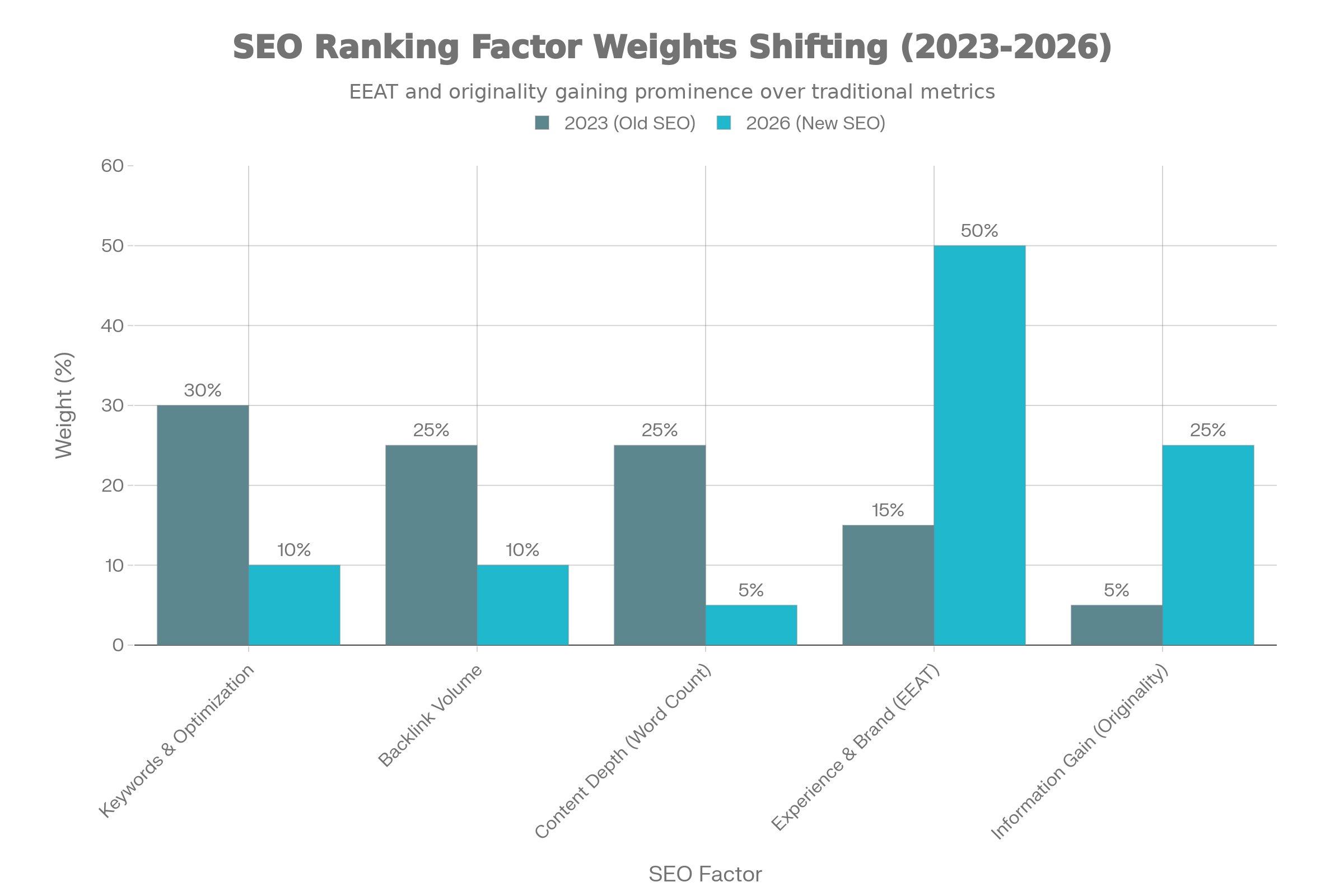
| Ranking Factor | Importance in 2023 | Importance in 2026 |
|---|---|---|
| Experience & Brand | Moderate (E-E-A-T) | Critical (50%) - Who are you? Why should we trust you? (Real social proof, author schema). |
| Information Gain | Low | High (25%) - Did you say something new, or did you just rephrase the top 10 results? |
| Technical/Keywords | High | Baseline (20%) - Necessary (speed, mobile-friendly), but no longer a differentiator. |
| Word Count | High | Irrelevant (5%) - Only "Time to Result" matters. |
Strategy for 2026
If you go back to blogging this year, adopt the "E-E-A-T First" doctrine:
- Experience: Lead with "I." ("How I Fixed My Sink" vs. "How to Fix a Sink").
- Expertise: Stick to one vertical where you have proven knowledge.
- Authoritativeness: Build your brand off-site (LinkedIn, YouTube) to signal trust to Google.
- Trust: Cite your sources and audit your facts.
Conclusion: The "lazy" blog is dead. The "expert" publication is just getting started. If you are willing to put your face and reputation behind your content, 2026 is arguably the best time to start, because your competition—the generic content farms—have just been wiped out.
Frequently asked questions
Is blogging still profitable in 2026?
How did the December 2025 Core Update affect travel and recipe blogs?
Can I use AI to write my blog posts if I edit them heavily?
What is "Information Density" in SEO?
How long should a blog post be in 2026?
Free for subscribers
Get the free Career Prompt Vault
Fill-in-the-blank AI prompts for your resume, cover letter, LinkedIn and interviews. Works with ChatGPT, Claude and Gemini.
You’re in.
Unlocked. Every prompt in the vault is yours.
Check your inbox to confirm your subscription.
Open the Career Prompt Vault