

The Philippines’ IT-BPM industry closed 2024 with 1.82 million jobs and $38 billion in revenue, even as AI anxiety continued to grow across the sector. That is the first clue that the story is not “BPO is dying.” It is “BPO is changing fast.”
The jobs most exposed to automation are the routine ones, especially repetitive customer support and back-office tasks. But even in contact centers, the latest tools are still being used to assist humans, not fully remove them.
That is why the real question behind AI BPO jobs in the Philippines is not whether AI will touch the industry. It already has. The question is which parts of the work will shrink, which parts will grow, and how Filipino workers can move toward the higher-value roles that AI is creating.
What AI Is Already Doing in BPO Work
AI is already taking over the easiest, most repetitive parts of contact-center work. In McKinsey’s 2025 contact-center analysis, gen AI was described as useful for handling simple queries, providing live translations, summarizing issues, and reducing after-call work. That means less time spent on note-taking and basic routing, and more time spent on the conversations that actually need human judgment.
That shift is visible in the tools major companies are rolling out. Reuters reported in June 2024 that Microsoft was bringing AI to customer service call centers to help with chatbot responses, help-manual lookup, and agent assistance. In other words, the industry’s direction is already clear: AI is becoming the first layer of support, while humans stay on the harder cases.
For Filipino workers, that means the most common BPO tasks are no longer “safe” just because they happen in an office. If a process is repetitive, text-heavy, rule-based, and easy to document, it is also easier to automate.
Why the Philippine BPO Industry Is Especially Exposed
The Philippines has built a huge white-collar workforce around support services, and the scale matters. In the PSA’s 2022 Annual Survey of Philippine Business and Industry, the broader administrative and support service section employed 1,364,700 workers. Within that section, call centers and related activities had the highest average number of workers per establishment and generated PhP 602.04 billion in revenue, accounting for 76 percent of the section's total.
That does not mean every one of those jobs is at risk tomorrow. It does mean the country’s biggest outsourcing engine is concentrated in a part of the labor market that AI can affect quickly, especially when the work is standardized. The World Economic Forum’s 2025 Future of Jobs Report says clerical and secretarial workers, including administrative assistants, executive secretaries, data entry clerks, and bank tellers, are expected to see the largest declines in absolute numbers over 2025 to 2030.
That combination is why the debate around the future of BPO in the Philippines feels so intense. The sector is large, profitable, and globally important, but a meaningful share of its work fits the exact profile that AI loves most: repetitive language work, process-heavy workflows, and predictable customer requests.
Why This Does Not Mean the BPO Industry Is Disappearing
The strongest argument against a collapse story is that the industry is still growing. Reuters reported in October 2024 that the Philippine IT-BPM industry was expected to grow 7 percent that year, reaching 1.82 million jobs and $38 billion in revenue. The same report noted that 8 percent of IBPAP members had already reported headcount reductions because of AI, but 13 percent reported gains. That is a disruption story, not a death story.
IBPAP’s own 2028 roadmap is even more telling. The industry plan calls for about 2.5 million jobs and $59 billion in annual revenue by 2028, while explicitly pushing the sector toward higher-complexity, higher-skill work and stronger upskilling. The roadmap also calls for a national talent upskilling program and stronger digital literacy, including coding.
That is the big strategic shift. The Philippine outsourcing industry is not trying to defend every low-complexity role forever. It is trying to move up the value chain. Reuters quoted IBPAP president Jack Madrid as saying that the country cannot remain known only for low-complexity jobs, and that workers need in-demand skills like IT support, cybersecurity, data analytics, and AI.
Which BPO Jobs Are Most Likely to Change First?
The most exposed roles are the ones that look easy to standardize. Basic voice support, script-based chat support, repetitive email handling, simple ticket triage, and routine back-office processing are all vulnerable because AI can already handle a big share of the first-pass work. McKinsey says gen AI can manage simple queries and summarize issues, which reduces call times and after-call work for agents.
That does not mean call center agents vanish. It means the job changes. The routine part gets smaller, and the human part gets more valuable. Escalations, retention calls, sales conversations, complaint handling, and emotionally charged customer interactions are much harder to automate because they depend on persuasion, context, and trust. McKinsey also notes that human-powered contact centers remain crucial for risk control and for combining human and AI intelligence.
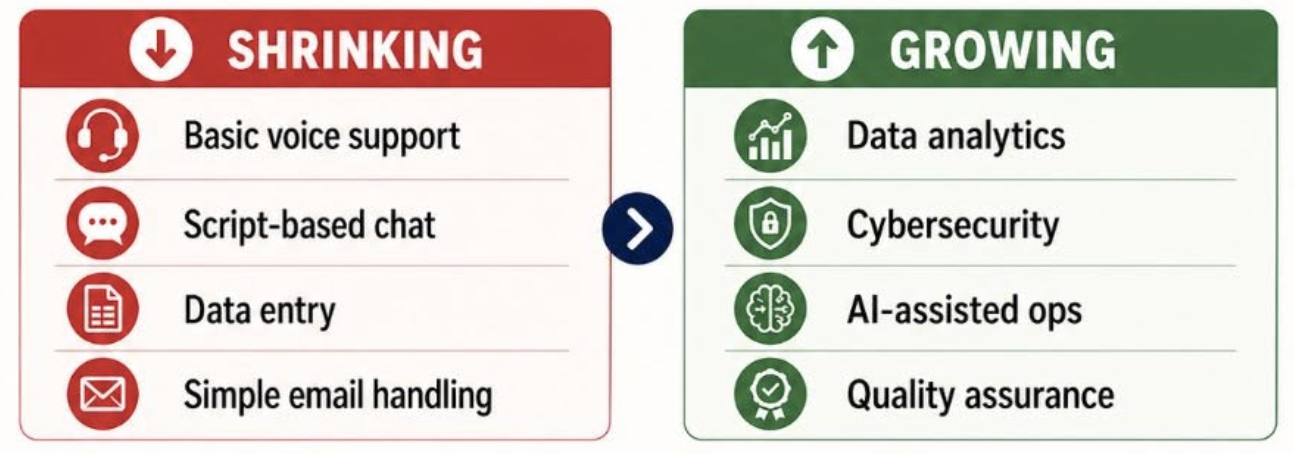
Back-office work is also under pressure. The WEF’s 2025 report shows the steepest declines in clerical and secretarial roles, which is a warning sign for data entry, scheduling, document checking, and administrative coordination. Those jobs may not disappear, but the volume of pure manual processing is very likely to fall.
Where the Next Growth in BPO Will Come From
The safest path inside BPO is not to stay where AI is strongest. It is to move into work that still needs human judgment, domain knowledge, and accountability. That is why IBPAP’s roadmap emphasizes higher-skill services, specialized talent, and digital capability building.
The likely growth areas include workforce management, quality assurance, training, knowledge management, customer-experience design, multilingual support, analytics, cybersecurity, and AI-assisted operations. Reuters reported that IBPAP is urging workers to build skills in IT support, cybersecurity, data analytics, and AI because those are the areas the industry expects to need more of.
There is also a broader policy push in the Philippines to prepare workers for this shift. The Institute for Labor Studies, the research arm of DOLE, has been public about the need for human-centric AI transition, upskilling, and reskilling. In 2026, ILS said skills gaps and workforce readiness will determine how much the country benefits from AI, and it highlighted ongoing efforts to strengthen capabilities in emerging technologies.
What Filipino BPO Workers Should Do Now
The smartest move is not to panic. It is to become the person AI helps rather than the person AI replaces.
Start with the skill areas the market keeps repeating: AI tools, analytics, cybersecurity, digital literacy, and domain specialization. Those are the exact areas Reuters, IBPAP, and DOLE-linked labor researchers keep pointing to as the next layer of demand.
Then work on the human skills that AI still struggles with. The WEF says analytical thinking remains the most sought-after core skill, followed by resilience, flexibility, leadership, and social influence. In BPO terms, that translates to better escalation handling, stronger communication, better coaching, and more confidence in client-facing work.
If you are already in a call center, the best upgrade is to move from pure execution work into problem-solving work. Learn how to read dashboards, identify patterns in customer issues, document processes, and use AI tools to shorten response time without lowering quality. That is where the job market is heading, and it is also where pay tends to improve. This is an inference from the current industry roadmap, not a guarantee, but it matches the direction IBPAP and labor officials are describing.
Will AI Replace Call Center Agents in the Philippines?
Some will be automated. Many will be transformed. A smaller number may disappear.
That is the most realistic answer based on the current evidence. AI is already taking over the simplest interactions, but the Philippine BPO sector is still growing, still hiring, and still planning for a larger future built around higher-value services. The jobs most likely to survive are the ones that require empathy, accountability, sales skills, nuanced judgment, and the ability to handle messy human situations.
So the answer to whether AI will replace call center agents is not a clean yes or no. It will replace some tasks, reshape many roles, and push the strongest workers into more complex work. That is uncomfortable, but it is also an opportunity for Filipino workers who are willing to adapt early.
The Bottom Line
AI is not wiping out the Philippine BPO industry. It is stripping away the easiest work and rewarding the people who can do more than follow a script.
That is why the safest strategy for workers is simple. Learn the tools, build the human skills, and move toward work that needs judgment, trust, and context. The companies that win will be the ones that combine AI efficiency with Filipino communication skills. The workers who win will be the ones who do the same.