Investing Apps for Passive Income: A Beginner's Guide for 2026
How investing apps pay passive income through dividends and interest, which app and account to pick in the US or UK, and how much income to expect.

In this article 12 sections
- Investing apps pay passive income through dividends, interest and distributions, plus growth you can sell later.
- Cash and short-term government bills pay the most "safe" income right now because interest rates are relatively high.
- A broad S&P 500 fund yields only about 1%; most of its long-run return has historically come from growth.
- Hold your income investments in a Roth IRA (US) or Stocks and Shares ISA (UK) first to keep more of what you earn.
- Any app promising fixed daily returns is a red flag; check the broker on FINRA BrokerCheck or the FCA Register.
Investing apps can pay you passive income in three main ways: dividends from stocks and funds, interest from bonds and cash, and growth you can sell later. A realistic starting point is a broad dividend or index fund inside a tax-sheltered account (a Roth IRA in the US or a Stocks and Shares ISA in the UK), with automatic deposits and dividend reinvestment switched on.
Search "passive income app" and you will find two very different things: regulated brokers that let you own real companies and funds, and flashy apps promising daily returns that are often scams. This guide is about the first kind. It explains where the income actually comes from, which type of app fits which goal, how much you can realistically expect, and how to keep your money safe. It is written for beginners in the US and UK, with notes for readers elsewhere.
Boredlisted has no affiliate deals with any app mentioned here. Information comes from official provider pages and government sources, listed at the end. This is general education, not personal financial advice.
What counts as passive income from an investing app?
Passive income from an investing app is money your investments pay you without you selling anything or doing extra work. The two main forms are dividends, a share of company profits paid to shareholders, and interest, paid by bonds, Treasury bills and cash balances. Funds pass both along to you as distributions.
The word "passive" describes the effort after setup, not the risk. Dividends can be cut, interest rates fall, and the value of your holdings moves every day. What makes the income passive is that, once you have chosen your investments and automated your deposits, the payments arrive on their own, usually monthly or quarterly.
There is also a third, quieter source: growth. A broad index fund may pay a small dividend but grow in value over time. Many people build wealth this way first, then shift toward higher-income investments later, or sell a small slice each year to create their own "income." Both approaches count, and most long-term investors use a mix.
What are the main ways an investing app can pay you?
Here are the income sources you will find inside most regulated investing apps, ordered roughly from lower to higher risk. The yield ranges are rough guides as of October 2026 and change with markets and interest rates, so treat them as a sense of scale, not a promise.
| Income source | How it pays you | Rough yield range (Oct 2026) | Main risk |
|---|---|---|---|
| Interest on uninvested cash or a money market fund | Monthly interest on cash waiting in your account | Tracks central bank rates, around 3.5% to 4% in the US and UK; many apps pay less | Rates can drop quickly; some apps pay far below the market rate |
| Treasury bills or UK gilts | Interest at maturity or twice a year | Close to central bank rates for short-term bills | Low default risk; prices move if you sell longer bonds early |
| Bond funds and ETFs | Monthly distributions | Often 3.5% to 5%, depending on the bonds held | Fund value falls when interest rates rise |
| Broad index funds (S&P 500, global) | Quarterly or semiannual dividends | About 1% for the S&P 500 | Stock market swings; most of the return comes from growth |
| Dividend-focused ETFs | Quarterly or monthly dividends | Often 2.5% to 4% | Stock market swings; concentrated in fewer sectors |
| Individual dividend stocks | Usually quarterly dividends | Varies widely | One company can cut its dividend or fall sharply |
| Real estate investment trusts (REITs) | Quarterly or monthly dividends | Often 3% to 5% | Sensitive to interest rates and property markets |
Two things stand out. First, the "safest" income today comes from cash and short-term government debt, because interest rates are relatively high: the US Federal Reserve raised its target range to 3.75% to 4.00% in September 2026, and the Bank of England held Bank Rate at 3.75% the same week. Second, a broad stock index fund pays surprisingly little in dividends, because most of its long-run return has historically come from rising prices rather than payouts.
If dividends are your main focus, our guide to the best dividend investing apps for beginners compares six US apps on reinvestment, fractional shares and fees.
Which type of investing app fits your passive income goal?
Most investing apps fall into four types. The right one depends less on brand and more on how much you want to decide yourself.
| App type | US examples | UK examples | Best for | Watch out for |
|---|---|---|---|---|
| Full-service broker | Fidelity, Charles Schwab, Vanguard | Vanguard UK, Hargreaves Lansdown, AJ Bell | Building a long-term income portfolio with retirement accounts | More menus to learn; some UK platforms charge a percentage fee |
| Trading-first app | Robinhood, Public, Webull | Trading 212, Freetrade | Simple buying of shares and ETFs from your phone | Options, crypto and alerts that push you to trade; FX fees on US shares for UK users |
| Automated or robo-advisor | M1 Finance, Betterment, Wealthfront | Nutmeg, Moneybox, InvestEngine | Hands-off investing that reinvests and rebalances for you | Management fees on top of fund fees |
| Micro-investing or round-up | Acorns, Stash | Moneybox, Chip | Building the habit with spare change | Flat monthly fees can be large compared with a small balance |
For income specifically, look for four features before anything else:
- Free automatic dividend reinvestment, often called DRIP, so every payout buys more shares without effort.
- Fractional shares, so small deposits and small dividends get fully invested instead of sitting as cash.
- A tax-sheltered account, such as a Roth IRA or a Stocks and Shares ISA, so you keep more of what you earn.
- Clear income tracking, showing upcoming payment dates and a running total of income received.
Fees and features change often, so confirm the details on each provider's official pricing page before you open an account.
Which account should your passive income live in?
The account you open inside the app decides how much of your income you keep. This is where the US and UK differ most.
| Question | United States | United Kingdom |
|---|---|---|
| Main tax-sheltered account | Roth IRA (or traditional IRA, or a workplace 401(k)) | Stocks and Shares ISA (or a SIPP pension) |
| 2026 contribution limit | $7,500 a year across all IRAs ($8,600 if 50 or older) | £20,000 a year across all ISAs (2026/27 tax year) |
| Tax on income inside the account | None in a Roth IRA if you follow the withdrawal rules | None on dividends or interest inside an ISA |
| Tax on dividends outside it | Qualified dividends taxed at 0%, 15% or 20%; ordinary dividends at your income tax rate | First £500 tax-free, then 10.75%, 35.75% or 39.35% depending on your tax band (2026/27) |
| Flexible account with no limit | Taxable brokerage account | General Investment Account (GIA) |
For most beginners, the order is simple: fill the tax-sheltered account first, then use a regular account for anything extra. In the US, a Roth IRA requires earned income and has income limits, so check that you qualify on the IRS website. In the UK, note that dividend tax rates rose by 2 percentage points in April 2026, which makes an ISA more valuable than before.
UK readers buying US shares: the US withholds tax on dividends paid to foreign investors. Filling in a W-8BEN form, which most UK apps prompt you to do at sign-up, usually cuts that to 15% under the US-UK tax treaty. This applies even inside an ISA.
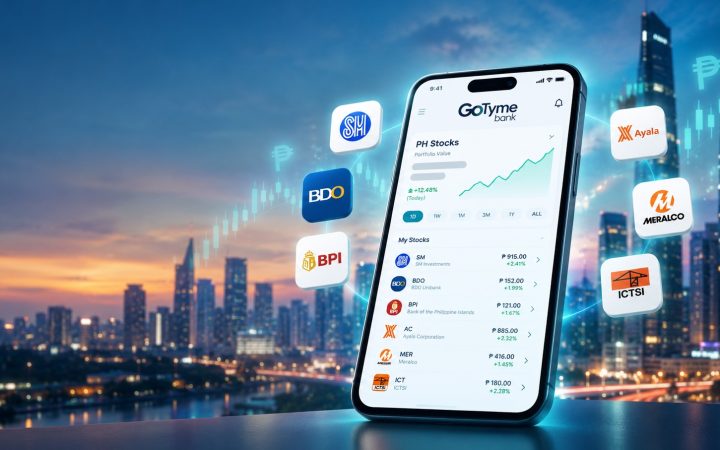
Readers in the Philippines: the same ideas apply through local apps. Our guide on investing in stocks with GoTyme walks through the process step by step.
How much passive income can you realistically expect?
Your yearly income is roughly your portfolio value multiplied by its yield. The table below shows what that looks like at three yields: about 1% (a broad S&P 500 fund), 3.5% (a dividend ETF or bond fund) and 4% (a higher-income mix). Figures are before tax and rounded, and the same math works in pounds.
| Portfolio value | At 1% yield | At 3.5% yield | At 4% yield |
|---|---|---|---|
| $10,000 | $100 a year (about $8 a month) | $350 a year (about $29 a month) | $400 a year (about $33 a month) |
| $50,000 | $500 a year (about $42 a month) | $1,750 a year (about $146 a month) | $2,000 a year (about $167 a month) |
| $100,000 | $1,000 a year (about $83 a month) | $3,500 a year (about $292 a month) | $4,000 a year (about $333 a month) |
| $250,000 | $2,500 a year (about $208 a month) | $8,750 a year (about $729 a month) | $10,000 a year (about $833 a month) |
Turned around, earning $500 a month ($6,000 a year) takes about $150,000 at a 4% yield, about $171,000 at 3.5%, and about $600,000 at 1%. That is why chasing a higher yield is tempting, and also why it is risky: unusually high yields often signal a falling share price or a payout that may be cut.
Here is a hypothetical path. Say you invest $200 a month for 20 years and your portfolio averages a 6% total return per year. You would put in $48,000 and end with roughly $92,000. Shifted into investments yielding 3.5%, that pot would pay about $3,200 a year, or around $270 a month. The 6% return is an assumption for illustration only; real returns vary and some years are negative. The point is that passive income is built slowly, and the deposits you make in the early years do most of the work.
How do you set up an investing app for passive income?
Setup usually takes under an hour once your identity is verified. Follow these steps in order:
- Get your base ready. Keep an emergency fund in cash and clear high-interest debt first. Money you need within three to five years belongs in savings, not stocks.
- Check the app is regulated. Look up a US broker on FINRA BrokerCheck or a UK firm on the FCA Financial Services Register.
- Open the right account. A Roth IRA in the US or a Stocks and Shares ISA in the UK, unless you have already used your allowance.
- Automate a monthly deposit. Set a recurring transfer for the day after payday, even if it is only $25 or £25.
- Buy one core holding. A broad index fund or a diversified dividend ETF is a sensible first investment for most beginners.
- Switch on dividend reinvestment. Check the setting for the whole account and for each holding, because some apps leave it off by default.
- Review quarterly. Confirm deposits went through and dividends were reinvested, then close the app.
If you are starting small, our step-by-step guide on how to start investing with $100 shows exactly what to tap inside an app to make your first purchase.
Should you reinvest dividends or take the cash?
While you are still building your portfolio, reinvesting is usually the stronger choice. Each reinvested dividend buys more shares, and those shares pay their own dividends, so your income grows even in months when you add nothing. This compounding effect is the main engine behind long-term passive income.
Taking the cash makes sense once the income has a job to do: covering a bill, topping up an emergency fund, or supplementing your salary. Many investors reinvest for years, then switch the setting to "pay to cash" when they are ready to live on part of the income. In a regular taxable account, remember that dividends are usually taxable in the year you receive them, even if you reinvest them.
Is your money safe in an investing app?
Two different risks are worth separating. The app could fail, which is what investor protection schemes cover. The market could fall, which no scheme covers. Losing money because share prices drop is a normal part of investing, not something you can claim back.
| Protection | Country | What it covers | Limit |
|---|---|---|---|
| SIPC | US | Missing securities and cash if a member brokerage fails | $500,000 per customer, including up to $250,000 in cash |
| FDIC | US | Cash swept into partner banks if a bank fails | $250,000 per depositor, per bank, per ownership category |
| FSCS (investments) | UK | Investments if an authorized investment firm fails | £85,000 per person, per firm |
| FSCS (deposits) | UK | Cash held in a UK bank or building society | £120,000 per person, per authorized bank (since December 1, 2025) |
Regulated brokers must also keep client assets separate from their own money, so a failure usually means a transfer to another firm rather than a loss. Check which protection your specific app offers in its legal or security pages.
What are the red flags of a fake passive income app?
"Passive income" is one of the most common phrases in investment scams. Be cautious of any app or platform that:
- Promises fixed daily or weekly returns, or "guaranteed" income from stocks or crypto.
- Cannot be found on FINRA BrokerCheck or the FCA Register, or copies the name of a real firm.
- Was recommended by a stranger, a new online friend or a group chat "mentor."
- Asks you to pay a fee or tax before you can withdraw your own money.
- Is only available through a download link rather than the official App Store or Google Play listing.
If you think you have been targeted, stop sending money and report it: to the FTC and SEC in the US, or to Action Fraud and the FCA in the UK.
Guides in this series
- How to Start Investing in Stocks with GoTyme: A Beginner's Guide
Learn how to invest in PH stocks with GoTyme. Step-by-step setup, fees, taxes, and beginner tips to buy your first shares with just a few hundred pesos.
- Best Dividend Investing Apps for Beginners in 2026
Compare the best dividend investing apps for beginners in 2026, from Fidelity to M1 Finance, and learn how to set up automatic dividend reinvestment.
- How to Start Investing With 100 Dollars: A 2026 App Guide
See how to start investing with 100 dollars using a beginner app: pick an account, buy fractional shares or index funds, and avoid fees that eat returns.
The bottom line
The best investing app for passive income is a regulated one with free dividend reinvestment, fractional shares and a tax-sheltered account you will actually use. Start with a broad fund, automate a monthly deposit and reinvest every payout while you build. The income will feel small at first. That is normal, and it is also how every meaningful income stream starts.
Your next step this week: open a Roth IRA or Stocks and Shares ISA in one app, set a recurring deposit you can afford, and switch on dividend reinvestment. For more plain-language guides, browse our money and personal finance hub, or grab a budgeting template from the resource library to find the monthly amount.
This article is for education only and is not personal financial advice. Investing involves risk, and you could get back less than you put in. Rates, limits and app features change, so check official sources before acting.
Sources
Facts checked as of October 13, 2026.
- IRS: IRA contribution limits
- IRS Publication 550: Investment income and expenses
- GOV.UK: Individual Savings Accounts (ISAs)
- GOV.UK: Tax on dividends
- SIPC: What SIPC protects
- FDIC: Deposit insurance
- FSCS: What we cover
- Federal Reserve: Open market operations and policy rate
- Bank of England: Bank Rate
- FINRA BrokerCheck
- FCA Financial Services Register
Frequently asked questions
Can you really make passive income from an investing app?
What is the best investing app for passive income?
How much do I need to invest to earn $500 a month in passive income?
Are dividends from investing apps taxed?
Is it safe to keep money in an investing app?
Should I reinvest dividends or take the cash?